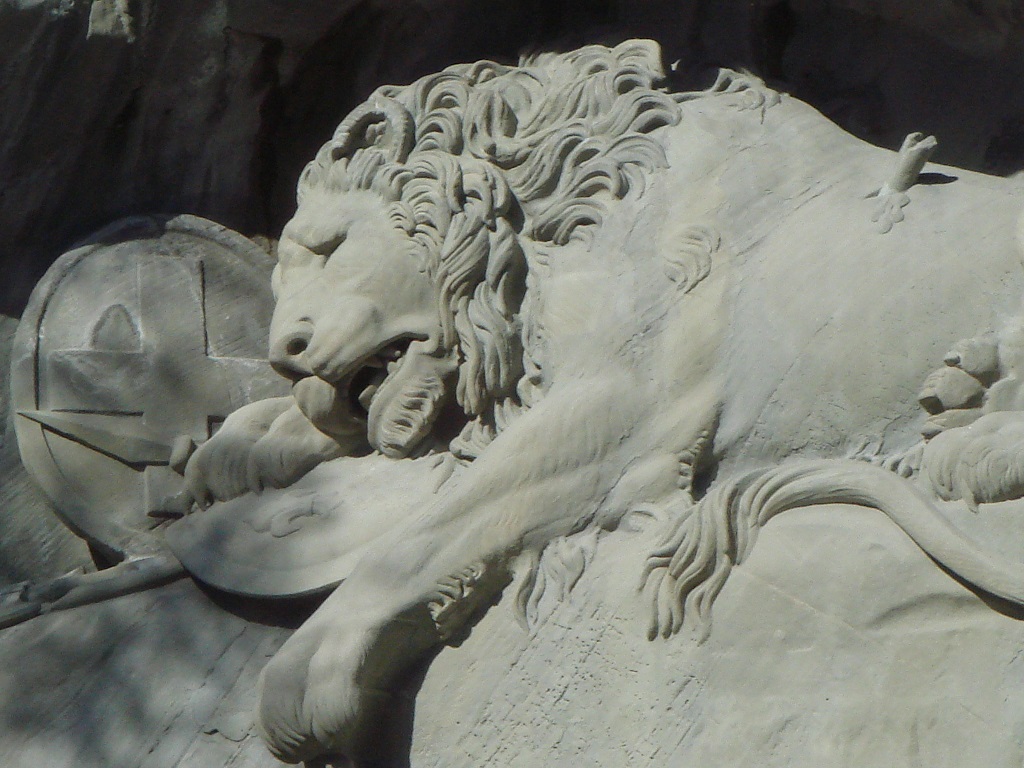
 The
Lion Monument in
Lucerne
,
the most sentimental of
Swiss
Monuments, commerates the
Swiss
mercenaries
who, serving the
French
King Louis XVI, lost their lives
during the French Revolution at the Tuileries Palace in Paris .
Many were killed during the invasion of the Tuileries on
the 10th August 1792 while others were guillotined on the
2nd and 3rd September 1792. The inscription above the Lion
reads "Helvetiorum fedei ac Virtuti" which translates
as "To the loyalty and bravery of the Swiss." A
fitting tribute.
The
Lion Monument in
Lucerne
,
the most sentimental of
Swiss
Monuments, commerates the
Swiss
mercenaries
who, serving the
French
King Louis XVI, lost their lives
during the French Revolution at the Tuileries Palace in Paris .
Many were killed during the invasion of the Tuileries on
the 10th August 1792 while others were guillotined on the
2nd and 3rd September 1792. The inscription above the Lion
reads "Helvetiorum fedei ac Virtuti" which translates
as "To the loyalty and bravery of the Swiss." A
fitting tribute.
Carved into the cliff face, the monument measures a staggering 10 meters in length and and six meters in height. Captain Carl Pfyffer von Altishofen commissioned the Lion Monument which, in turn, was designed by the Danish classicist sculptor Bertel Thorvaldsenwhilst in Rome in 1819. Lucas Ahorn, a stone-mason from Constance in modern day Germany, carved the sculpture out of the limestone cliff face in 1820 and 1821.
At the time of the French Revolution, Swiss Mercenaries, along with agriculture and town-crafts, were an important and gainful trade during the Ancien Regime as a whole with as many as 40,000 serving under foreign banners when the French Revolution started in 1789.
The Monument was inaugurated on the 10th August 1821 and was purchased by the town of Lucerne in 1882.