We took the Christmas Eve Special tickets, for a grand total
of 25GBP each, which included some mulled wine and a performance
by a Chinese dragon.
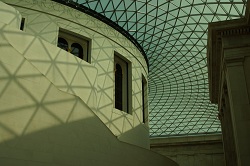
After some rest, relaxation and entertainment in the Grand
Court of the British Museum we entered the exhibition in the
specially-adapted Reading Room.
As part of our trip through the exhibition, we also took the
audio guide which included commentary by the Director of the
Museum and the Curator of the China and Korea section which
we found to be highly information and an excellent accompaniment
to the exhibition.
While the purpose of the exhibition was to guide us through
the life and times of The First Emperor, which it achieved
in it's entirety, the undoubted star of the show were the exhibits
of the show were the artefacts from the excavation sites of
the Terracotta Army.
At the beginning of the exhibit, we were treated to a display
of a kneeling crossbowman. Poised - at the ready. The level
of detail in the archer, in spite of the absent crossbrow,
was astounding. Detail in the armour and expression was fantastic.
Some of colour remained stained on the terracota which allowed
you to imagine what it would once have looked like.
As we continued through the exhbition, we would learn about
how the Emperor standardised distances, weights and measures
and organised the civil service. And all this while expanding
his empire to include the other states which would come to
be known as China.
Just as griping as the kneeling crossbowman, were two generals,
a soldier, an archer and civil servants which were also on
display. What was amazing about these displays is that they
are lifesize, typically standing at around 1.90 meters in height.
The individuality of each statue is exemplified not only, for
example, that one general is armoured and the other not but
also the different faces and expressions. The two generals,
for example, differed in that one was bearded and the other
not. The archer, holding a lowered bow, appeared to be in the
depths of concentration. The civil servants stood posed with
their hands covered under their long garments to indicate that
they were not manual workers. The stains on the figures showed
us where the colours would once have been but have now, over
time, faded from sight. One was left to imagine the splendour
that these figures would once have displayed.
At the end of the exhibition, we were treated to a fine reconstruction
of the kneeling crossbowman we had encountered at the beginning
of the exhibition. This time, fully painted and decorated as
the crossbowman would have looked when he was new. This was
an excellent addition to the exhibition as it helped to bring
the exhibit to life.
As we hope to visit the Terracotta Army during our 2009
trip to China, this exhibition was provided a welcome
oppurtunity to learn more of Chinese history as well as see
the Army up which, we understand, just isn't possible in
China itself.
I would like to take this oppurtunity to thank all those involved
in this marvellous project for the oppurtunity this affords
us mere mortals.
The British Museum has, once again, excelled itself at providing
an excellent exhibition for which they were are to be congratulated.
London - The First Emperor at the British Museum
24th December 2007
As was non-exclusively reported on this site, the British Museum is currently running an exhbition about the First Emperor of China, featuring the Terracotta Army which was inscribed on the UNESCO World Heritage List in 1987.
We took the Christmas Eve Special tickets, for a grand total of 25GBP each, which included some mulled wine and a performance by a Chinese dragon.
After some rest, relaxation and entertainment in the Grand Court of the British Museum we entered the exhibition in the specially-adapted Reading Room.
As part of our trip through the exhibition, we also took the audio guide which included commentary by the Director of the Museum and the Curator of the China and Korea section which we found to be highly information and an excellent accompaniment to the exhibition.
While the purpose of the exhibition was to guide us through the life and times of The First Emperor, which it achieved in it's entirety, the undoubted star of the show were the exhibits of the show were the artefacts from the excavation sites of the Terracotta Army.
At the beginning of the exhibit, we were treated to a display of a kneeling crossbowman. Poised - at the ready. The level of detail in the archer, in spite of the absent crossbrow, was astounding. Detail in the armour and expression was fantastic. Some of colour remained stained on the terracota which allowed you to imagine what it would once have looked like.
As we continued through the exhbition, we would learn about how the Emperor standardised distances, weights and measures and organised the civil service. And all this while expanding his empire to include the other states which would come to be known as China.
Just as griping as the kneeling crossbowman, were two generals, a soldier, an archer and civil servants which were also on display. What was amazing about these displays is that they are lifesize, typically standing at around 1.90 meters in height. The individuality of each statue is exemplified not only, for example, that one general is armoured and the other not but also the different faces and expressions. The two generals, for example, differed in that one was bearded and the other not. The archer, holding a lowered bow, appeared to be in the depths of concentration. The civil servants stood posed with their hands covered under their long garments to indicate that they were not manual workers. The stains on the figures showed us where the colours would once have been but have now, over time, faded from sight. One was left to imagine the splendour that these figures would once have displayed.
At the end of the exhibition, we were treated to a fine reconstruction of the kneeling crossbowman we had encountered at the beginning of the exhibition. This time, fully painted and decorated as the crossbowman would have looked when he was new. This was an excellent addition to the exhibition as it helped to bring the exhibit to life.
As we hope to visit the Terracotta Army during our 2009 trip to China, this exhibition was provided a welcome oppurtunity to learn more of Chinese history as well as see the Army up which, we understand, just isn't possible in China itself.
I would like to take this oppurtunity to thank all those involved in this marvellous project for the oppurtunity this affords us mere mortals.
The British Museum has, once again, excelled itself at providing an excellent exhibition for which they were are to be congratulated.
Related posts