 The
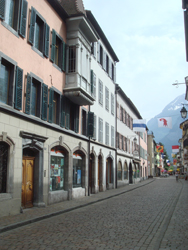
old town of Saint Maurice, while small and initially unremarkable,
is one of the most historic cities in Valais and home to
the oldest Abbey north of the Alps.
The
old town of Saint Maurice, while small and initially unremarkable,
is one of the most historic cities in Valais and home to
the oldest Abbey north of the Alps.
Located strategically at the entrance to an Alpine pass, where the Alps narrow, the Romans developed this place they knew as Acaunnus with its ample water supply from the Rhône river to secure control over the Valais region. Although previously under Celtic control, Acaunnus was heavily fortified by the Romans and legions were stationed to secure the pass. The Theban Legion, who converted to Christianity, defied the authority of Rome which demanded reverance for the divinty of the Emporer as a God and were persecuted and decimated for the thir faith. Saint Maurice, commander of the Legion, was amongst those martyred in the third century and the town and Abbey now bear his name in testament. Subsequently, the Merovingians, Carolingians, Burgundians, Savoyards and the Holy Roman Emporers contributed to make this small town an important spiritual and liturgical centre.
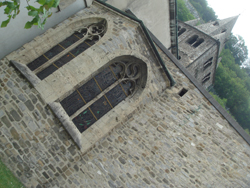 The
Abbey, catacombs, the original (now destroyed) and current
churches and the tombs of Saint Maurice all formed part of
the third and final tour of the day which worth every centime
of the 10 Francs costs. (Guided tours times are available
at the Abbey
website.) The Abbey of Saint Maurice, as a functioning
Territorrial Abbey Augustine Rule, was founded in 515 on
the site of a former Roman temple. Evidence of the temple
still exists in the Catacombs where a section of a Roman
temple archway is now integrated into the structure of catacombs
walkway.
The
Abbey, catacombs, the original (now destroyed) and current
churches and the tombs of Saint Maurice all formed part of
the third and final tour of the day which worth every centime
of the 10 Francs costs. (Guided tours times are available
at the Abbey
website.) The Abbey of Saint Maurice, as a functioning
Territorrial Abbey Augustine Rule, was founded in 515 on
the site of a former Roman temple. Evidence of the temple
still exists in the Catacombs where a section of a Roman
temple archway is now integrated into the structure of catacombs
walkway.
Our tour took us through the important treasury which houses
three reliquaries of significant historical importance. 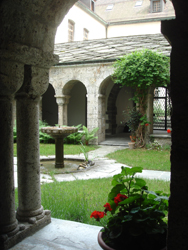 These
reliquaries are masterpieces of workmanship in silver and
woods and unlike many other reliquaries of their age which
have either been destroyed or removed to museums - these
works of art survived intact within the place they were intended
for. Further in the treasury, artefacts of medieval art and
artefacts from the 2nd and 3rd century including a thorn
from the Crown of Thorns which Jesus was made to wear during
his crucifixion and a golden jug of the Carolingian period
decorated with semi-precious stones presented to the Abbey
by Charlemagne.
These
reliquaries are masterpieces of workmanship in silver and
woods and unlike many other reliquaries of their age which
have either been destroyed or removed to museums - these
works of art survived intact within the place they were intended
for. Further in the treasury, artefacts of medieval art and
artefacts from the 2nd and 3rd century including a thorn
from the Crown of Thorns which Jesus was made to wear during
his crucifixion and a golden jug of the Carolingian period
decorated with semi-precious stones presented to the Abbey
by Charlemagne.
The Catacombs, mustier than the rest of the abbey, provide
access to the tombs that once lay here. The passage way along
the catacombs, a steel walk way brings you across a small
street running through, leads through to the the ruins of
the original church of the monastry. A rock fall in the early
17th Century destroyed the original church which lay along
an east/west axis. Not daring to erect another church in
the original position the present church, along a north/south
axis, is set away from the sheer cliff face along which the
original cliff face was erected. In the Apse of the original
church, the tomb of Saint Maurice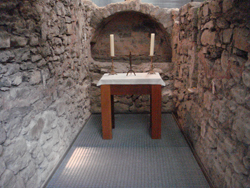 remains
and small alter has been errected in his honour. The remains
of the church remains an archeological site having been so
since 1945 and the reconstruction of the church remains,
it appears, a distant possibility.
remains
and small alter has been errected in his honour. The remains
of the church remains an archeological site having been so
since 1945 and the reconstruction of the church remains,
it appears, a distant possibility.
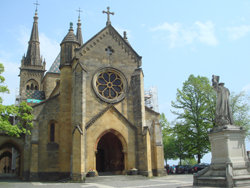
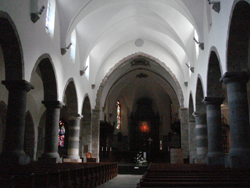
The current Church, the start and end of our tour, contains elements of the XIth, XVIIth and XXth century elements but still retains all the fundamental elements of its Gothic origins. It essentially retains the simplicity of the Gothic period with three aisle structure and pointed columns. With late adjustments made to allow the original Romanesque bell tower to be integrated with the new church and a baroque style lantern to be added in the right hand aisle.
 The
history of the Abbey, tied as it is to Theban Legion, is
closely tied to the legends of the founding of
Zürich
and
Grossmünster
in
particular. Our tour, for a simple 10CHF, was worth every
penny.
The
history of the Abbey, tied as it is to Theban Legion, is
closely tied to the legends of the founding of
Zürich
and
Grossmünster
in
particular. Our tour, for a simple 10CHF, was worth every
penny.
Tours of the Abbey take around 90 minutes and are offered several times daily. Details of tour times can be found on the Abbey website.
Tour language is decided according to demand so our tour was in French - so a basic understanding of at least some French is probably a good idea in case numbers go against you.