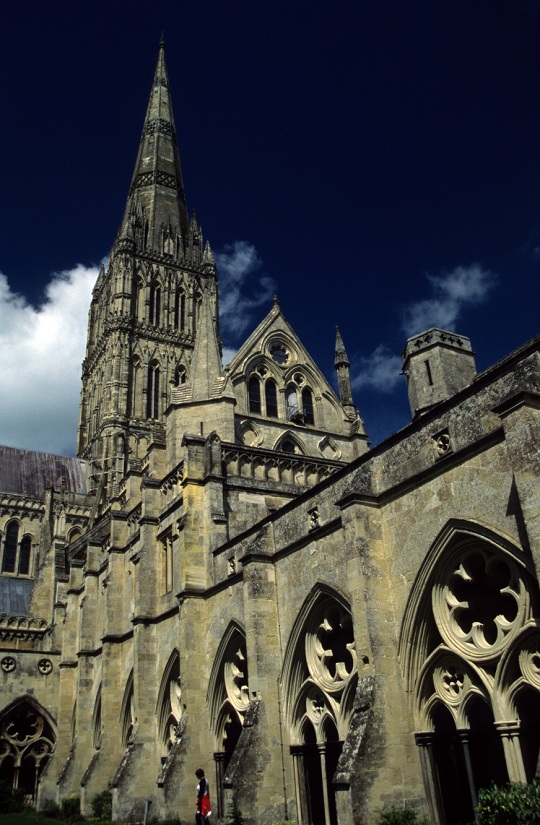
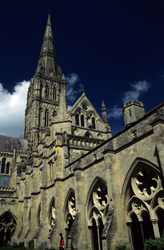
 Salisbury has a very medieval-England old town with a world-class
cathedral. In cathedral building terms, Salisbury Cathedral
was built remarkably quickly, taking only 38 years, commencing
in 1220 and finishing in 1258, and is almost entirely in one
architectural style - Early English Gothic.
Salisbury has a very medieval-England old town with a world-class
cathedral. In cathedral building terms, Salisbury Cathedral
was built remarkably quickly, taking only 38 years, commencing
in 1220 and finishing in 1258, and is almost entirely in one
architectural style - Early English Gothic.
At 404 feet, the Cathedrals spire is the tallest in England. When it was placed on the on the cathedral, the central point of the central point of the cathedral the Cathedrals columns bowed. When this was realised, the scissor arches were added as were the flying butresses, which proved to be more effective.
In the North Transept, there is a tomb. The tomb has roses engraved around the top - each one identical. When facing the tomb, examine the roses before heading to the left of the tomb where, in the place of one of the roses, you will find a face with a pair of scissors cutting the ribbon which binds the roses.
In the Quire, the cielings were repainted during the Victorian period in what the Victorians believed to be the Gothic style of painting. When in the Choir, look back to the cieling of the nave. At each point, there appears to be a piece of triangular damp on either side.
In the Chapter house adjoing the cathedrals cloister is Salisburys copy of Magna Carta. Only four copies of the Magna Carta survive and the Magna Carta at Salisbury is the best preserved of those that were faithfully copied and distributed after King John signed his concessions to the Barons in 1215 at the meadow in Runnymede.
Salisbury is also home to Europe's oldest working clock, which was built in 1386. It has no face but has a mechanism which strikes at on the hour. It was designed this way in order to allow people (who might not be able to read a clock) to be aware of what time it was - e.g. time for church, time for work.
The Audley Chapel, located on the North Side of the High Altar, was defaced during The Reformation (which was the period of seperation of the Roman Church and the Church of England.) The symbol of one of Henry VIII (sadly, I forget which one) wives was the pomygranite. After their seperation, Henry VIII ordered the destruction of her symbol from all property in England. On the roof of the interior of Audley chapel, remain some pomygranites which were missed by Henrys men.
The cathedral is primarly constructed from Jurassic limestone and the pillars from marble.
Salisbury also boasts the largest complete set of choir stalls in Britan as well as the Britains largest set of Cathedral cloisters.