Berne - a short city guide

Berne, the is the Swiss capital and capital of the canton of the same name, boasts an impressive UNESCO-listed medieval old town - which is primarily responsible for my small-time love affair with Bern and it now ranks as of my favorite cities in Switzerland. Nestled on a peninsula of the River Aare, the Old Town is an absolute delight to spend several hours walking around.

Main sights

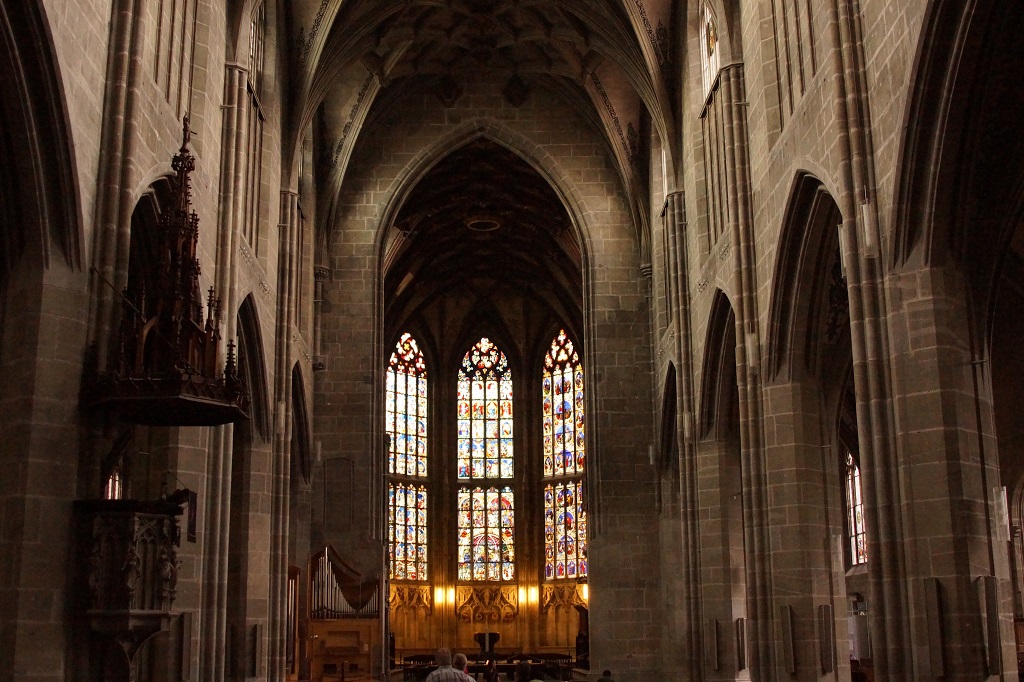
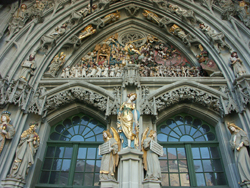
  1. The main door of Berne Münster including the sculpture of The Last Judgement The Berne Münster (Cathedral) is the largest gothic building in Switzerland with a 100 meter tower. Entry to the cathedral is free, but for a few francs you can climb the tower for fantastic views of the old town. IMO, the views from the top of spire is worth every franc and every step up and down.

  2. The Berne Old Town (Altstadt) is a UNESCO listed gem and is remarkably well preserved. The cobbled streets of the medieval old town, perched on a pensinsular in Aare river, and the arcaded a pleasure to simply stroll through and do a spot of shopping (including undestreet shops) in what is supposed to be the worlds longest collection of arcaded shopping and is a joy to walk around.

  3. Albert Einsteins House in Kramgasse is of historic importance as this is where Albert Einstein wrote his most famous equation E = mc2 and his Special Theory of Relativity. Einsteins Annus Mirabilis, 1905, saw five revolutionary papers written as follows:

    1. On a Heuristic Point of View Concerning the Production and Transformation of Light (For this paper on the photoelectric effect he received the Nobel Prize of 1921.)
    2. On the Movement of Small Particles Suspended in Stationary Liquids Required by the Molecular-Kinetic Theory of Heat (On a problem in statistical mechanics)
    3. On the Electrodynamics of Moving Bodies (Special theory of relativity)
    4. Does the Inertia of a Body Depend upon Its Energy Content? (Equivalence of mass and energy and the theory which gave us E = mc2)
    5. A New Determination of Molecular Dimensions (His doctoral dissertation)
    6. On the Theory of Brownian Motion (Published in 1906)
    I won't bore you with the details of such theories - but there they are.

  4. The Clock Tower (Zytglogge) dates from 12th / 13th Century (1191 - 1256) marks the boundry of the citys first expansion and the main entrance to the Old Town from the station side. The impressive astronomical clock on the exterior masks the towers previous varied uses as a guard tower and prison.

  5. The Swiss Federal Parliament is based in Berne - in its capacity as the Swiss Capital. The Parliament building, also known as the Federal Palace, was built to the designs of the architect H. Auer and inaugurated in 1902. The two houses which form parliament sit in seperate chambers which meet in the "Hall of the Dome" which is decorated by various symbols of Switzerland. The glass dome, for example, is decorated with the coats of arms of 22 Cantons while the Coats of Arms of Jura is shown seperately along with the date of the cantons accession to the Union (1978). Guided tours of the Parliament building are available when Parliament is not sitting.

  6. Bear pits - the bear is the symbol of Berne and bears are kept in the pits - albeit controversially amongst the opinions of m'colleagues.


Related posts